
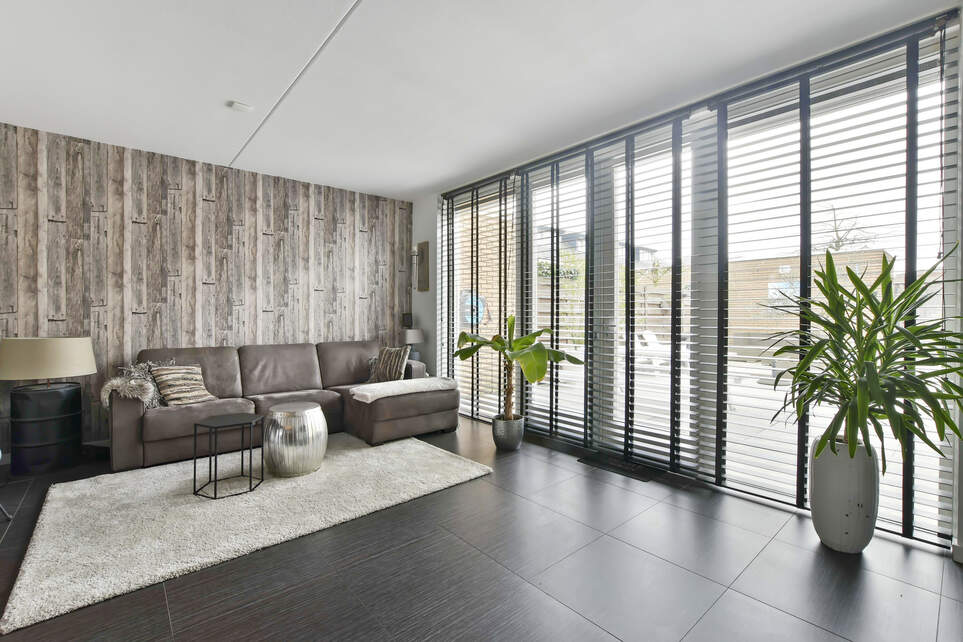
Bay windows instantly add character to a room, and they provide plenty of natural light. However, they are among the more challenging window arrangements to dress correctly. The difficulty isn’t measuring each individual window; it’s understanding how the blinds will sit alongside one another, how they will operate and what happens at the corners.
At Cambridge Blinds, we offer a range of made-to-measure blinds and shutters. Before making any recommendations, we consider the shape of the bay, how you use the room, and the level of light control you need. The aim is to find a covering that looks right and works in everyday life, rather than choosing a style based on appearance alone.
Why Bay Windows Need Careful Measuring
Bay windows come in several different configurations, including angled bays, square bays and curved arrangements. Each presents its own fitting considerations. One of the main challenges is the interaction between adjacent blinds. Headrails, brackets and operating mechanisms can take up more space than the fabric, and where two sections meet, these components can interfere with one another if the arrangement hasn’t been planned correctly.
This can affect how the blinds sit alongside each other and may create gaps that are more noticeable than expected. The correct measurements therefore need to account for the full blind assembly, not just the fabric width.
The available space at the corners is also important. We need to establish how the fittings will sit, whether there’s sufficient clearance and how the individual blinds will look when raised and lowered. These details can make a significant difference to the finished appearance. A blind that looks suitable in a photograph might not be the best option for the particular shape and dimensions of your bay.
Understanding Light Gaps and Fabric Choices
It’s worth being realistic about how much light a blind can exclude. Customers sometimes expect blinds to meet perfectly at the corners, creating an uninterrupted covering across the whole bay. In reality, most blind systems require some clearance, and the amount of light entering around the edges depends on the product and how it’s fitted.
Roller blinds are a good example. There is commonly a difference between the overall mechanism width and the actual fabric width, so a strip of glass may remain visible at the side. In a bay window, these gaps can become particularly noticeable at the corners.
Fabric choice is also important. Translucent and screen fabrics allow daylight to pass through, while dim-out fabrics reduce incoming light more substantially. Blackout fabrics are designed to block light through the material, but that doesn’t necessarily mean you will achieve complete blackout unless the selected system and installation arrangement can genuinely meet that level of light exclusion. Light may still enter around the edges or between sections.
Likewise, solar-control fabrics can perform differently depending on openness factor, colour, window orientation and external conditions. So, if you need strong light exclusion, we’ll consider the complete system and its fitting arrangement rather than promising blackout simply because a particular fabric is described as blackout.
Which Blind Styles Work Well in Bay Windows?
Different blind styles offer different ways to balance appearance, privacy and daylight.
Roller Blinds
Roller blinds provide a clean, contemporary appearance and a wide choice of fabrics. They can work well when you want a relatively understated covering, although they’re not always the best option when you’re concerned about light gaps at corners.
Venetian Blinds
Venetian blinds can also work well in bay windows, offering adjustable light and privacy throughout the day by tilting their slats. However, you need to consider the headrail position, slat movement, and corner interactions.
Duette Blinds
Duette honeycomb blinds are an option worth discussing, especially in colder rooms. Their cellular fabric construction can provide useful thermal benefits, and different operating arrangements can help balance daylight and privacy.
Top-down/bottom-up arrangements, where available, can be particularly effective in bay windows. They let you maintain privacy across the lower portion of the glazing while admitting daylight above, which can be useful in street-facing rooms.
Ultimately, the best choice depends on the shape of the bay, the room and the result you’re looking for. No single blind style is automatically right for every configuration.
Could Shutters Be a Better Choice?
Blinds aren’t the only option for bay windows. Shutters can be particularly suitable where you want a more permanent, architectural finish that follows the shape of the window. Our shutter range includes plantation, solid and café styles, offering different approaches to appearance, privacy and light control.
Shutters can work well across suitable bay windows, but they also have practical considerations. The frame depth, available fixing space, window handles and opening clearances all need to be assessed. Frames and louvres also reduce the visible glass area, which can affect how much daylight enters the room.
For some homeowners, plantation shutters provide the traditional, fitted appearance they want. Others might prefer blinds because they offer a softer fabric finish or better suit their light-control needs. We would consider both options where appropriate rather than assuming one is always the better choice.
Everyday Use Matters as Much as Appearance
The best blind for a bay window isn’t necessarily the one that looks best in a photograph. The way you use the room should influence your choice. For example, if you want daytime privacy in a street-facing living room while retaining natural light, you might benefit from a completely different product than a bedroom needing maximum darkness.
In either case, we also need to consider practical details, such as access for cleaning the windows, reaching window handles and opening individual sections. The layout of the bay can affect these, and when several blinds sit close together, their operating mechanisms and the space between them can influence how convenient they are to use.
It’s worth considering how the window coverings will look when raised, too. A consistent arrangement can help the bay feel complete, even where the individual sections differ in size. These are the details that help turn a suitable product into a well-planned installation.
Experience From a Bay Window Project
We recently surveyed a square bay where the customers wanted cassette roller blinds. What they hadn’t appreciated was that, in a square bay, something has to take priority at the corners, because each cassette needs a certain width and depth. A cassette roller blind needs around 75 to 90 mm of depth, whereas the Duette blind we recommended instead needs as little as 25 mm. We gave the main window priority, made the two side blinds slightly smaller to allow for it, and the finished bay looked balanced and worked properly.
Finding the Right Covering for Your Bay Window
Bay windows can be attractive architectural features, but they’re not always easy to cover. We look at the dimensions, angles and available fitting space before recommending a product. We also consider what you need from the window covering, whether that’s daytime privacy, adjustable light control, thermal benefits or a particular interior finish.
Our recommendations are always based on what will work for your particular window, including the practical limitations of the chosen product. If one option is likely to leave more noticeable light gaps or make access difficult, we’ll explain that before you commit. We’d rather help you understand the advantages and disadvantages of each choice than promise a perfect result that the product can’t deliver.
To learn more about a particular product or book a home survey, get in touch today.